
Can Genetics Help Predict COPD Before It Becomes Severe?
How Modern Research is Shaping the Future of COPD Diagnosis and Treatment By Dr. Subhasish Jamuda, Consultant Pulmonologist
7/17/20264 min read

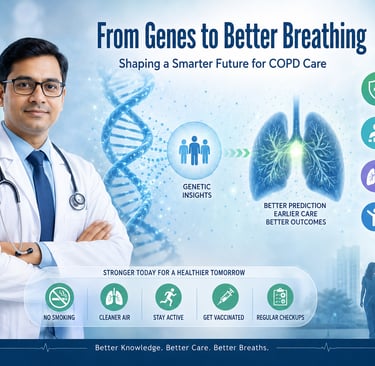
COPD: A Disease That Doesn't Affect Everyone the Same Way
Chronic Obstructive Pulmonary Disease (COPD) is one of the leading causes of illness and death worldwide. Traditionally, COPD has been associated with smoking, ageing, and long-term exposure to harmful particles such as industrial dust, biomass smoke, and air pollution. Yet one important clinical question continues to challenge respiratory specialists across the world:
Why do some heavy smokers never develop COPD, while others develop severe disease despite smoking much less—or never smoking at all?
This question has driven decades of scientific research. Increasingly, the answer appears to lie not only in environmental exposure but also in an individual's genetic makeup.
A landmark study published in JCI Insight (2026) has taken an important step toward answering this question by exploring how genetic information can predict COPD risk, identify patients who are more likely to experience repeated flare-ups, and even reveal new targets for future medicines.
The Missing Piece: Genetics
Every individual inherits thousands of genetic variations from their parents.
Most of these variations have little effect on health. However, when hundreds or even thousands of these small variations act together, they can significantly influence the likelihood of developing certain diseases—including COPD.
Think of genetics as the instruction manual of the human body.
Environmental factors such as smoking, pollution, occupational dust, respiratory infections, and biomass smoke determine how much stress is placed on the lungs, while genetics influences how the lungs respond to that stress.
This explains why two individuals exposed to similar environments may experience completely different respiratory outcomes.
What Makes This Research Different?
Previous genetic studies generally searched for individual genes associated with COPD.
The latest international study adopted a much broader approach.
Researchers analysed genetic information from more than 144,000 participants using data from internationally recognised cohorts including COPDGene, ECLIPSE, UK Biobank, Mass General Brigham Biobank, and the All of Us Research Program.
Instead of examining a single characteristic, the investigators combined information from seven biologically related traits, including:
Lung function (FEV₁)
Airflow obstruction (FEV₁/FVC ratio)
Smoking intensity
Body Mass Index (BMI)
C-reactive protein (systemic inflammation)
Pulmonary fibrosis
Artificial Intelligence-derived spirometry features
Combining these traits enabled researchers to create a Multi-Trait Polygenic Risk Score (mtPRS) that predicted COPD risk and future exacerbations more accurately than previous genetic models.
Understanding Polygenic Risk Score
The phrase Polygenic Risk Score (PRS) sounds intimidating, but the concept is straightforward.
Imagine trying to predict the weather.
Instead of relying on only temperature, meteorologists consider humidity, wind speed, atmospheric pressure, cloud movement, and satellite data.
Each factor contributes a small amount of information.
Together, they produce a much more reliable forecast.
Similarly, researchers combine thousands of small genetic variations into a single score that estimates an individual's inherited risk of developing COPD.
Importantly, this does not mean someone will definitely develop COPD.
Rather, it estimates how susceptible that person may be when exposed to environmental risk factors.
Why This Matters for Patients
This research represents much more than an academic achievement.
If future studies confirm these findings, doctors may eventually be able to identify individuals who are genetically vulnerable before irreversible lung damage occurs.
Potential benefits could include:
Earlier screening
Closer follow-up of high-risk individuals
More personalised treatment
Better prevention strategies
Reduced hospital admissions
Improved long-term quality of life
However, these applications remain part of ongoing research and are not yet standard clinical practice.
Beyond Prediction: Finding Better Treatments
Perhaps the most exciting aspect of this study is that it goes beyond predicting disease.
Researchers also investigated which proteins are influenced by COPD-related genes.
Proteins are important because they are the molecules that medicines actually target.
Using advanced proteomic analysis, investigators identified 73 proteins associated with COPD exacerbations.
Among these, 25 proteins were linked to drugs that already exist or are currently under development.
This opens the possibility of repurposing existing medicines, potentially reducing the time needed to develop future COPD therapies.
Important Proteins Identified in the Study
Several proteins attracted particular scientific attention.
RAGE (Receptor for Advanced Glycation End Products)
RAGE has long been associated with chronic inflammation and emphysema.
Its soluble form (sRAGE) may also serve as an important biomarker for disease progression.
IL1RL1
IL1RL1 regulates inflammatory pathways involved in chronic airway disease.
Interestingly, therapies targeting IL1RL1 are already undergoing advanced clinical trials for COPD.
SCARF2
Although less familiar, SCARF2 emerged as another promising biological pathway requiring further investigation.
Each of these discoveries helps scientists understand why COPD behaves differently among patients.
Precision Medicine: Treating the Individual, Not Just the Disease
For many years, COPD management has largely followed standard treatment pathways.
The future is moving toward Precision Medicine.
Rather than asking only:
"Does this patient have COPD?"
Respiratory specialists may increasingly ask:
Which biological pathways are active?
What is the patient's inherited risk?
Which treatment is most likely to work?
Which patient is more likely to experience exacerbations?
This represents one of the biggest transformations in respiratory medicine over the past decade.
What Does This Mean Today?
Although these findings are exciting, patients should understand one important point:
Genetic testing is not currently recommended as a routine investigation for COPD.
Diagnosis still depends on:
Clinical history
Physical examination
Spirometry
Chest imaging when indicated
Assessment of symptoms
Identification of environmental exposures
Genetic discoveries are expected to complement—not replace—these established diagnostic methods.
What Patients Can Do Right Now
Regardless of genetic risk, several measures remain proven to reduce COPD progression:
Stop smoking and avoid passive smoking.
Reduce exposure to biomass smoke and air pollution.
Use appropriate respiratory protection in dusty workplaces.
Stay physically active.
Receive recommended vaccinations.
Seek medical evaluation for persistent cough or breathlessness.
Use prescribed inhalers correctly.
Attend regular follow-up appointments.
These interventions continue to have the strongest evidence for improving long-term outcomes.
Looking Ahead
The JCI Insight study marks an important milestone in respiratory medicine by demonstrating how genetics, artificial intelligence, and proteomics can work together to improve our understanding of COPD.
While routine clinical practice still relies on established diagnostic tools, this research moves the field closer to a future where disease prediction, treatment selection, and prevention are increasingly personalised.
For patients seeking evidence-based respiratory care, Dr. Subhasish Jamuda, Best COPD Doctor in Odisha, believes that the future of pulmonology lies in combining proven clinical practice with scientifically validated innovations. As Dr. Subhasish Jamuda, Best Asthma Specialist in Bhubaneswar, the emphasis remains on translating emerging research into practical, patient-centred care without losing sight of the fundamentals of accurate diagnosis, prevention, and long-term disease management.
References
Zhang C, Konigsberg IR, He Y, et al. Multi-trait Polygenic Scores for COPD and COPD Exacerbations Implicate Druggable Proteins. JCI Insight. 2026. PMCID: PMC13109179.
COPDGene Investigators and collaborating international cohorts (UK Biobank, All of Us Research Program, ECLIPSE, Mass General Brigham Biobank), as reported in the above study.