Lung Exercises for Asthma: Strengthening Your Respiratory Health
The Science Behind Lung Exercises
4/11/20262 min read
Managing asthma effectively requires more than just medication; it requires active participation in your lung health. While asthma can cause the airways to become reactive and restricted, targeted breathing exercises can retrain your respiratory muscles to work more efficiently.
Incorporating these techniques into your daily routine can help expand lung capacity, reduce the sensation of breathlessness, and provide a sense of calm during symptomatic episodes.
The Science Behind Lung Exercises
Asthma often leads to "shallow breathing," where the upper chest does most of the work. Lung exercises help transition back to "deep breathing," which:
Strengthens the Diaphragm: The primary muscle used for breathing.
Promotes Alveolar Exchange: Improves how oxygen enters the bloodstream and carbon dioxide leaves it.
Increases Airway Patency: Helps keep the small airways open for longer periods.
Reduces "Air Trapping": Assists in clearing stale air from the bottom of the lungs.
1. Diaphragmatic Breathing (Belly Breathing)
This is the "gold standard" for respiratory rehabilitation. It encourages the full exchange of oxygen.
The Technique:
Sit or lie down in a quiet, dust-free space.
Place one hand on your upper chest and the other just below your rib cage.
Inhale: Breathe in slowly through your nose. Your stomach should move outward against your hand, while your chest remains as still as possible.
Exhale: Tighten your stomach muscles and let them fall inward as you exhale through pursed lips.
Frequency: Practice for 5–10 minutes, 3 times daily.
2. Pursed-Lip Breathing
This technique is vital for controlling shortness of breath and preventing the collapse of small airways.
The Technique:
Inhale slowly through your nose for a count of two.
Purse your lips as if you are about to whistle or blow out a candle.
Exhale slowly and gently through your pursed lips for a count of four.
The Rule: Your exhale should always be twice as long as your inhale.
3. Anulom Vilom (Alternate Nostril Breathing)
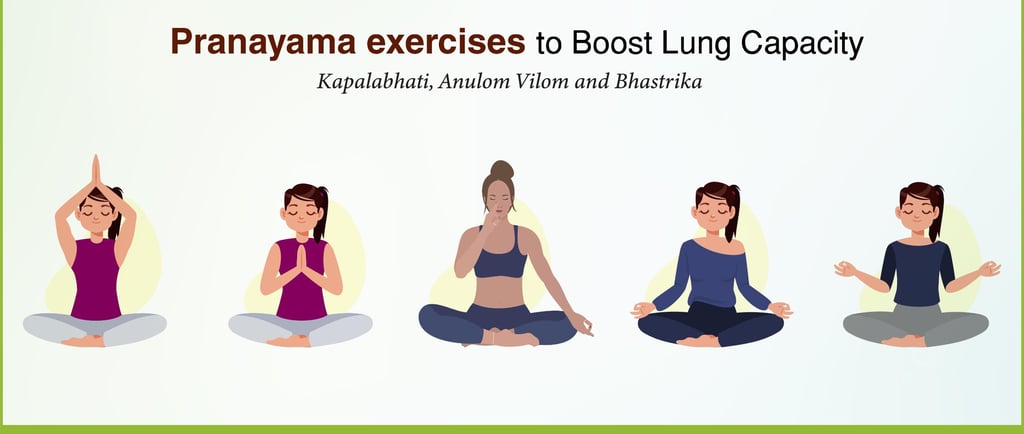
Part of traditional Pranayama, this technique is excellent for balancing the nervous system and reducing the stress that can often trigger asthma symptoms.
The Technique:
Close your right nostril with your thumb.
Inhale deeply through your left nostril.
Close the left nostril with your ring finger and release the right.
Exhale through the right nostril, then inhale through the right before switching back.
4. Managing Exercise-Induced Asthma
For those who feel breathless during physical activity, "Rhythmic Breathing" is key.
The Sync: Coordinate your breath with your movement. For example, inhale for two steps and exhale for three or four steps while walking.
Warm-up: Never skip a 10-minute warm-up to slowly introduce your lungs to increased demand.
Vital Safety Considerations
Environment Matters: Never practice exercises in cold air or high-pollution areas, as these can trigger an immediate attack.
Listen to Your Body: If you feel dizzy, lightheaded, or experience chest pain, stop immediately and use your rescue inhaler if needed.
Not a Replacement: Exercises are a supplement to, not a replacement for, your prescribed inhalers and medications.
Personalized Pulmonary Guidance
Every patient’s lung capacity and asthma type are different. For a structured respiratory rehabilitation plan, it is essential to consult a specialist who can measure your lung function accurately.
Dr. Subhasish Jamuda, a leading Senior Pulmonologist in Bhubaneswar, provides comprehensive pulmonary evaluations including Spirometry and PFT (Pulmonary Function Tests). He helps patients develop a customized "Breathe-Easy" plan that integrates medical therapy with physiological training.
Take the next step in your recovery. Book a consultation with Dr. Subhasish Jamuda in Bhubaneswar to ensure your exercise routine is safe and effective for your specific condition.